A remediation confidence score is a safety rating that tells you whether a cloud security fix can be applied without breaking production.
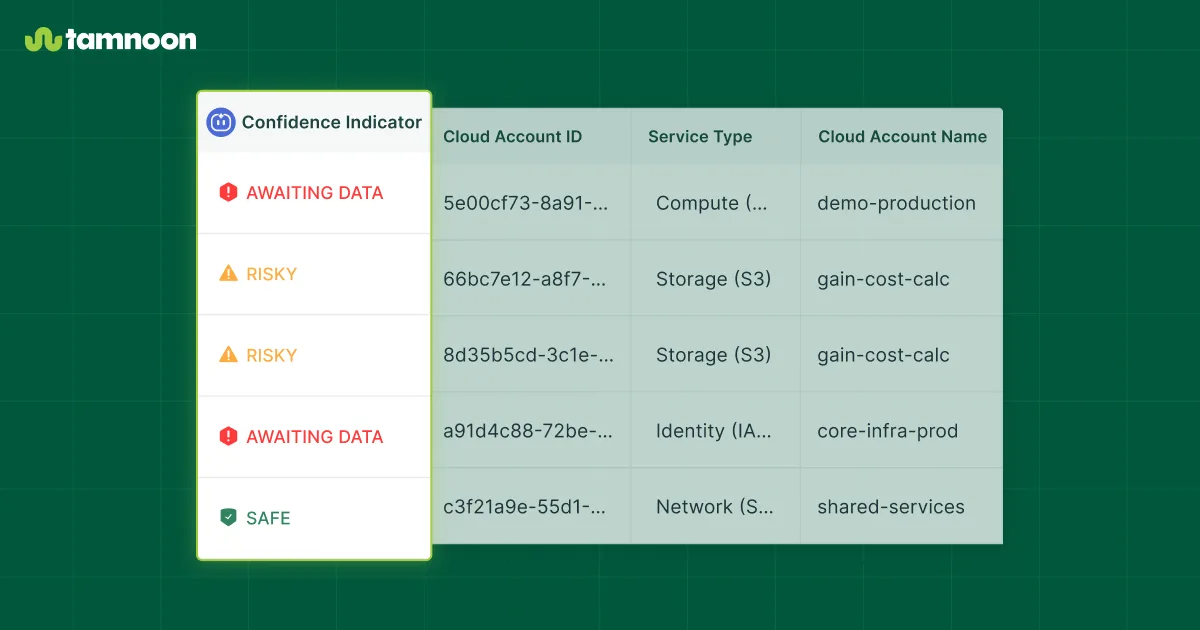
A remediation confidence score is a safety rating that tells you whether a cloud security fix can be applied without breaking production.
Tamnoon’s AI agent, Tami, scores every proposed fix as SAFE, RISKY, or AWAITING DATA by investigating the affected resource against live cloud data, mapping its dependencies, and calculating blast radius before any change is made.
Detection was never the hard part. Modern cloud security tools surface far more findings than teams can close, and the backlog keeps growing. Teams usually know exactly which alerts are open. In conversations with more than 800 cloud security teams, the most common reason a finding stays open is fear that the fix itself will take something down. Tightening a network policy can sever application traffic. Removing an IAM role can interrupt a running service. Encrypting a database can force an infrastructure rebuild. The finding is real, and so is the risk of fixing it, which is why industry data now puts the average time to remediate a critical cloud alert at 150 days.
A remediation confidence score settles the safety question before anyone touches the environment. Instead of asking an engineer to judge whether a fix is safe, it rates the fix from evidence. SAFE means proceed, RISKY means coordinate, AWAITING DATA means investigate further.
Tami calculates the score the way an experienced engineer would, only faster and against live data. Every input is read-only, so nothing in production is touched while the score is being built. (In Tamnoon’s platform documentation, the same rating is also called the Remediation Confidence Indicator, or RCI.)
To score a finding, Tami correlates several signals:
Together, these signals let Tami estimate the blast radius of the change, meaning how many systems could break if the fix goes wrong. A resource with no dependencies and no active traffic has a minimal blast radius, so the score is SAFE. A resource sitting in the request path of a production service has a large one, so the score is RISKY or AWAITING DATA. Because Tami is conservative by design, a finding it cannot confidently clear is never auto-remediated. It is routed to a human with the full investigation attached.
Each score sets a different next step:
Consider one CNAPP finding: a security group allowing inbound internet access. If nothing is attached to it, the score is SAFE and Tami tightens the rule automatically. If that same rule sits in front of a production load balancer carrying live traffic, the score is RISKY and the change is scheduled with the application team. Same finding, different score, because the environment is different. The score reflects the risk of the fix in your setup, not the severity label on the alert.
A remediation confidence score updates as the investigation progresses. A finding can open as AWAITING DATA while dependencies are unknown, move to RISKY once traffic patterns are partially mapped, and settle at SAFE once the blast radius is confirmed to be minimal. The more Tami learns about the resource, the more confident the score becomes.
The remediation confidence score is one of the skills Tami runs to turn CNAPP detection into safe, closed fixes. See how it works on the Tami platform page, or bring your top 10 unresolved CNAPP alerts to a 30-minute session, and we will show you which ones are safe to fix today.
Teardowns, CTF write-ups and field notes from the people who close cloud findings for a living.
You're subscribed.
That did not go through. Try again, or write to [email protected].
At most one email a month. Unsubscribe from any of them.